Every great city is defined not just by its skyline, but by the buildings people connect with emotionally. These are the structures that locals speak of with quiet pride and visitors capture instinctively—places that become inseparable from a city’s identity. Such landmarks are never accidental. They are shaped by foresight, deliberate design, and the ambition to build not only for the present, but for generations to come.
India stands at a defining moment in creating that legacy. Its urban transformation is unfolding at an unprecedented scale, and the choices made today will shape how its cities are experienced for decades.
A Transformation at Unprecedented Scale
 By 2047, India’s urban population is expected to cross 800 million, nearly double its current size. Across the country, new airports, transit systems, public institutions, and commercial hubs are rapidly taking shape. The question is no longer whether India will build at scale—it already is. The more pressing question is how it will build.
Urbanisation today brings complex challenges: rising temperatures, erratic climate patterns, changing work cultures, and growing expectations from urban spaces. Infrastructure must do more than perform a function. It must be adaptable, resilient, and capable of enhancing everyday experiences for millions of people.
From Construction to Legacy
In this evolving context, Tata Projects has positioned itself as more than an engineering and construction company. It aims to contribute to the creation of spaces with long-term civic and cultural value.
The New Parliament Building, designed to serve India’s democratic framework for decades, reflects a balance between symbolic importance and technical precision. The Noida International Airport is being developed as a gateway that mirrors the aspirations of a globally connected India. The Air India MRO facilities strengthen aviation infrastructure, while a growing portfolio of museums underscores a commitment to preserving cultural narratives.
These projects are not just infrastructure developments—they are statements of intent, designed with an understanding that they will outlast the moment in which they are built.
Designing for a Changing Future
One of the key realities of urban infrastructure is that user needs to evolve faster than buildings themselves. Offices, airports, and civic spaces must therefore be flexible enough to adapt over time.
Future-ready design incorporates modular construction, open layouts, and adaptable configurations that allow spaces to be reconfigured without major structural changes. Smart building systems, powered by IoT and data-driven insights, enable real-time responses to occupancy patterns, energy demands, and operational needs.
This approach is not about technology for its own sake. It is about ensuring that infrastructure remains relevant, efficient, and valuable throughout its lifecycle, reducing the need for costly upgrades or premature replacement.
Resilience at the Core
Climate resilience is now a central requirement for Indian cities. Rising heat, increased flood risks, and uneven energy availability demand buildings that can operate under stress.
Effective planning begins with understanding the local environment—solar exposure, wind direction, water resources, and material suitability. Incorporating natural ventilation, daylight optimisation, and durable materials reduces dependency on mechanical systems while improving sustainability.
For Tata Projects, resilience is embedded from the outset, ensuring that buildings are not only efficient, but also prepared for the realities of a changing climate.
The Human Dimension
While metrics such as efficiency, scale, and timelines are important, they do not fully define success. The true measure of a building lies in how it is experienced.
Human-centric design focuses on how people interact with spaces—how light affects mood, how acoustics influence productivity, and how movement through a building feels intuitive and seamless. Whether it is a calm airport terminal, an engaging museum, or a functional workplace, these elements turn infrastructure into meaningful environments.
When engineering excellence meets thoughtful design, buildings move beyond being functional assets to becoming places that people value.
Building with Intent
India’s urban growth will result in millions of new structures, but only some will stand the test of time. The difference lies in intent—whether projects are built for immediate delivery or long-term legacy.
Tata Projects approaches urban infrastructure with this long view, focusing on durability, adaptability, and user experience. The goal is to create spaces that grow in value over time, supporting not just cities, but the people who inhabit them.
As India continues to build its future, the responsibility is clear: to create infrastructure that is not only efficient and scalable, but enduring and inspiring.
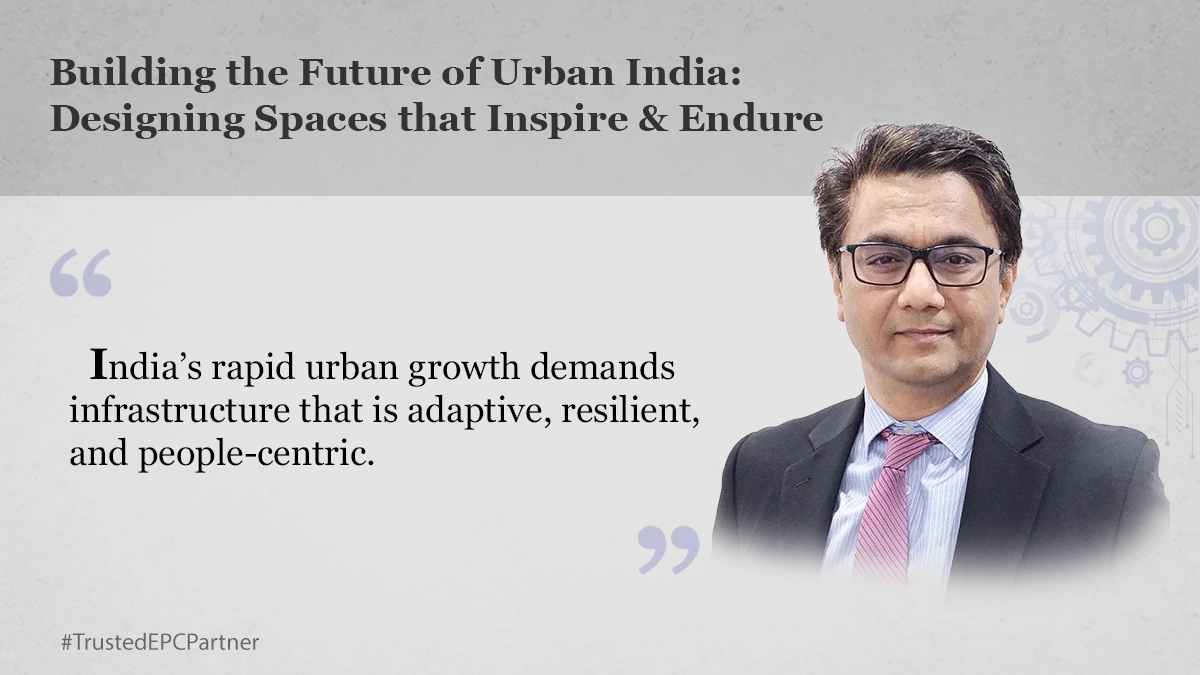
Barun Pal Chowdhury,
Executive Vice President & SBG Head - Urban Spaces
Tata Projects Limited
Simplify. Create.