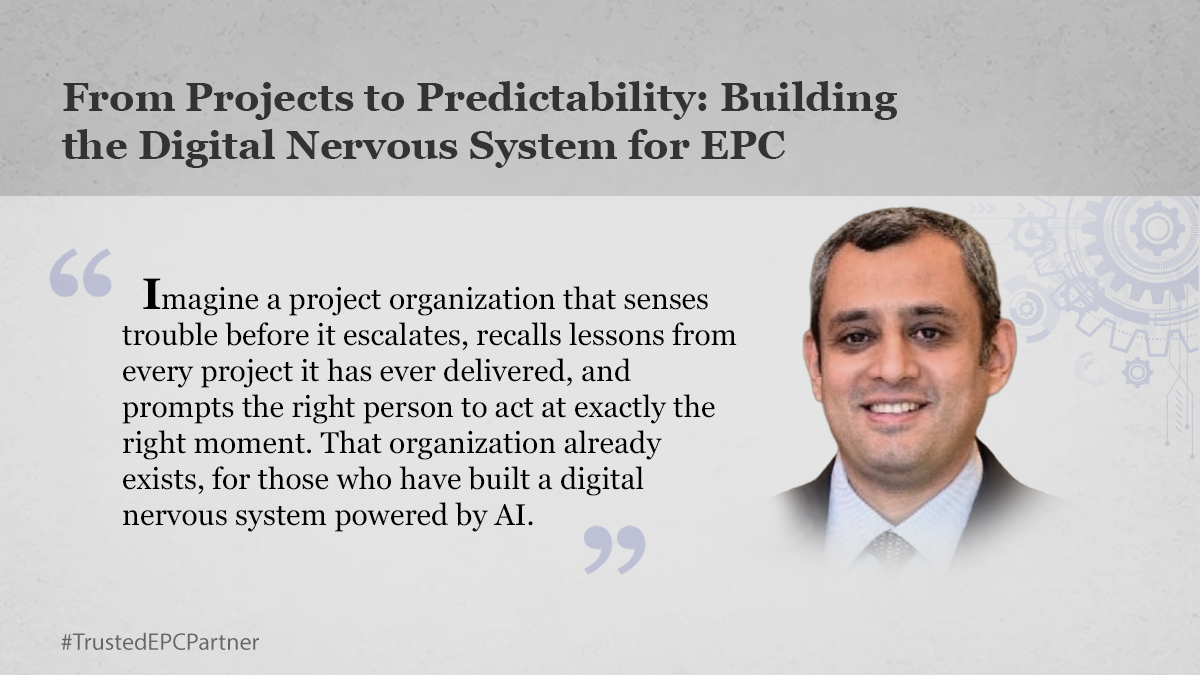
The Shift That Will Separate Leaders from the Rest: EPC has always been a business of managing complexity. Multiple stakeholders, fragmented data, site realities, and constant change, most organizations are structured to react to this complexity, not stay ahead of it. That is now changing. A new class of EPC firms is emerging, ones that do not just track progress but anticipate outcomes, surface risks early, and enable faster, better decisions on a scale. At the core of this shift is what we call a Digital Nervous System, an enterprise-wide intelligence layer powered by AI.
This is not a technological upgrade. It is a structural shift in how projects are delivered.
Digital Nervous System Means in EPC Context:
The analogy is worth taking seriously. The human nervous system does not just store information. It senses, transmits, interprets, and triggers action in near real time. A signal from your fingertip reaches your brain in milliseconds. Your brain does not merely log the signal in a report for review on Friday. It interprets it in context and fires a response immediately.
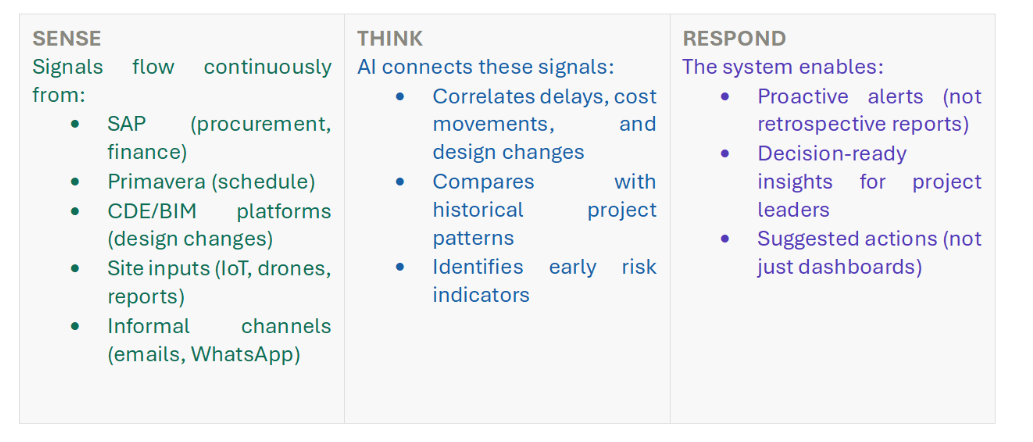
For an EPC firm, the equivalent is an organization-wide intelligence layer that connects every signal, from site, from finance, from procurement, from design, and acts on it with speed and context. Think of it in three ways:
This Matters Now (And Not Five Years Ago)
Connected systems have existed in EPC organizations for years. What has changed is AI’s ability to reason across them—connecting fragmented signals, identifying patterns, and translating data into foresight. This shift is unlocking a new operating model for EPC firms, moving them from reactive project management to predictable decision‑making.
- First, EPC is transitioning from experience‑based intelligence to system‑based intelligence. Traditionally, outcomes have depended heavily on a few seasoned individuals who know what to watch for and when to intervene. AI now makes institutional knowledge searchable and reusable, allowing insights from hundreds of past projects to inform decisions in real time. The result is greater consistency, reduced dependency on individuals, and scalability across projects.
- Second, organizations are shifting from lag indicators to lead indicators. Instead of discovering cost overruns and schedule slippages after the damage is done, AI identifies early warning signals—procurement delays, design churn, productivity patterns—that predict risk before it materializes. This enables a move from firefighting to foresight.
- Finally, EPC governance is evolving from periodic reviews to continuous decisioning. Rather than waiting for weekly or monthly cycles, leaders gain real‑time situational awareness and the ability to make continuous micro‑decisions. Most firms today operate with siloed systems and backward‑looking dashboards, but the real advantage lies in moving toward AI‑driven alerts and anticipation. In well‑defined workflows, the system can already prepare actions for human confirmation—compressing decision cycles and protecting margins where it matters most.
Position of EPC firms and the direction of travel:
· Level 1: Systems running in silos
· Level 2: Dashboards show the past
· Level 3: Alerts surface the present
· Level 4: AI anticipates what is next
· Level 5: System acts, human confirms
Most large EPC organizations today operate between Levels 1 and 2. Systems are in place, data is being generated, and reports are produced. The meaningful leap is to Levels 3 and 4, where the organization stops being a passive observer of its own projects and starts being a responsive, anticipatory intelligence.
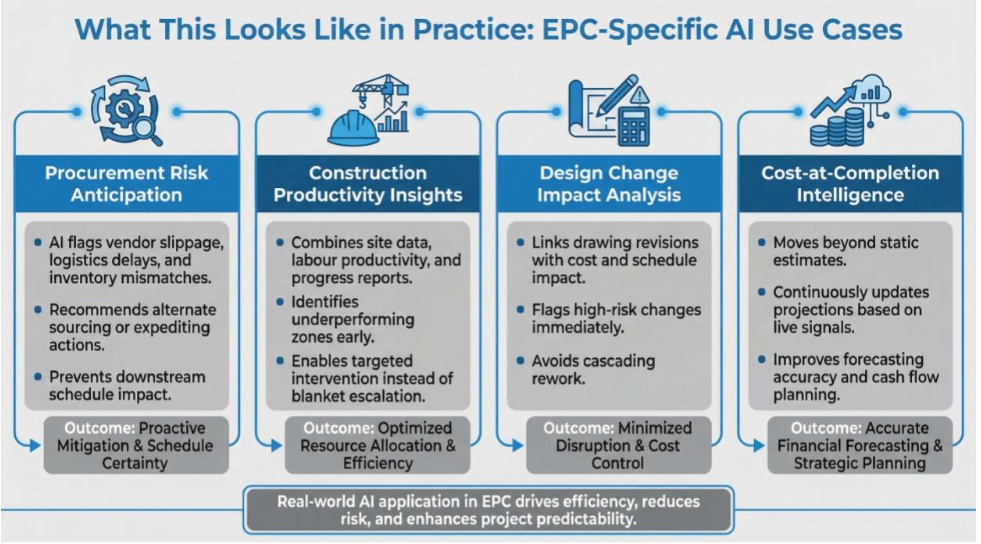
Level 5, where the system itself prepares the response and a human simply confirms it, is already achievable in well-defined workflows: automated procurement alerts, document routing, safety checklist generation, cost-at-completion updates. The human remains firmly in the loop. The machine does the work of recognizing the moment and preparing the action.
The Ambition is not Small:
The future of EPC is not about building faster. It is about knowing earlier, deciding quicker, and acting with precision.
The Digital Nervous System is not an IT initiative. It is the foundation for how projects will be delivered in a future-ready organization.
At Tata Projects, this aligns directly with our vision of building a future-ready, digitally enabled enterprise—where competitive advantage is defined by predictability, speed of decision-making, and precision in execution.
Vaibhav Palan,
Chief Digital & Information Officer
Tata Projects Limited
Simplify. Create.