For years, Building Information Modelling (BIM) was largely perceived as a design and visualization tool, a smarter way to create 3D models, coordinate drawings, and reduce clashes before construction began. While it helped with clash detection, better drawings, and smoother design coordination, it represented only the starting point of BIM’s true potential.
That approach is changing fast. Today, BIM is moving beyond modelling and becoming a management and collaboration tool that supports the entire project, from planning to construction and handover.
One of the biggest challenges in EPC projects is fragmentation. Engineering, procurement, and site teams often work in silos, using conflicting versions of information, which drives delays and escalating costs. The model becomes a single source of truth, not just a visual reference, ensuring total alignment between design intent, execution, cost, and schedule.
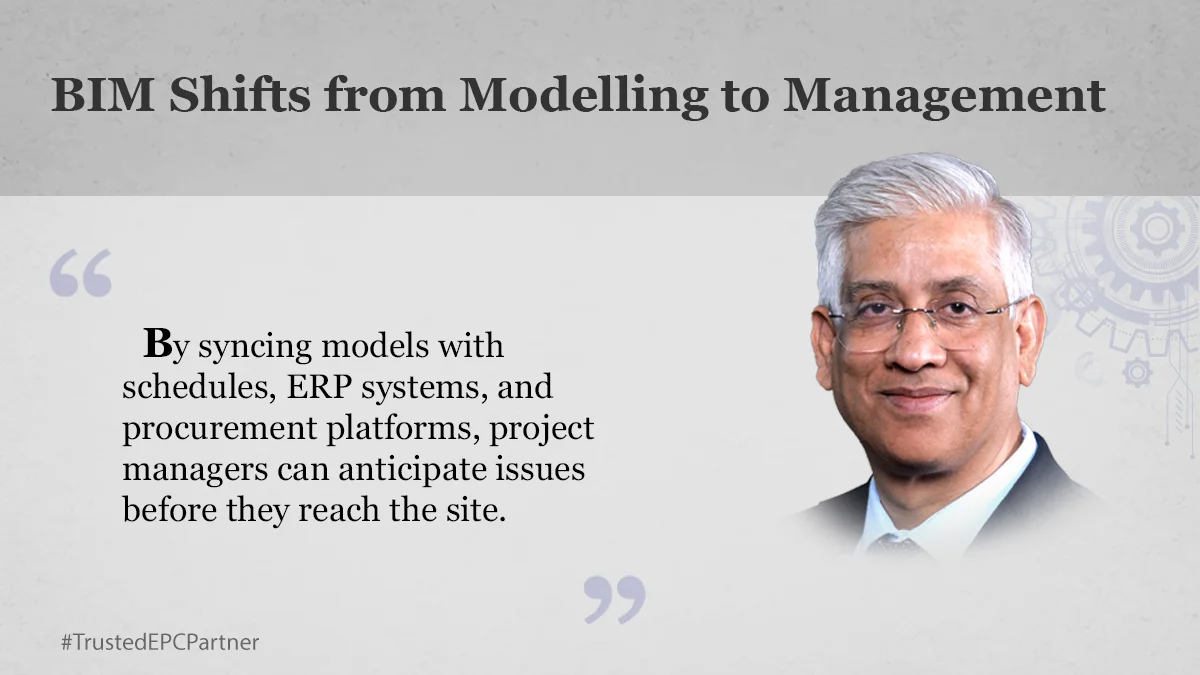
Moving BIM into a management role replaces reactive troubleshooting with a proactive, integrated workflow. By syncing models with schedules, ERP systems, and procurement platforms, project managers can anticipate issues before they reach the site. During execution, this connectivity allows for real-time tracking of quantities and progress. Instead of waiting for month-end reports, the impact of any change is understood instantly. This culminates in a structured digital handover, providing clients with a "Digital Twin" that extends the asset's value far into its operational life
As the industry evolves, the emphasis shifts from software proficiency to process design, data governance, and stakeholder coordination. BIM is no longer just a technical task; it is a comprehensive management system. BIM represents a new paradigm within EPC - one that encourages integration of stakeholders and has successful execution to bring about greater efficiency and harmony; this is evident from the successful implementation in Metro projects.
At its core, BIM’s transformative power lies in its ability to facilitate smooth collaboration and reduce fragmentation in the EPC industry. This culture of collaboration is more than a benefit; it is a necessity for the complex, fast-paced projects of the future. Ultimately, it leads to improved performance and reduced project costs.
Raman Kapil
President and COO, Buildings & Infrastructure
Tata Projects Limited
Simplify. Create.