A recent study published in Deloitte’s 2026 Manufacturing Industry Outlook, concludes that a renewed strategic focus and targeted technology investments would be essential to maintaining a competitive edge in 2026. This research also suggests that to lead better in the future, companies may need to put the customer at the heart of the digital transformation.
Ensuring the best ROI
For us, at Tata Projects, this is like music to our ears. Down the ages, we have always invested a lot in planning and thought to inject the latest technology and adopt innovations in our systems and processes. And all this, to guarantee the best ROI for our customers too.
We are proud to be unique in more ways than one. The latest buzzwords doing the rounds in our sector - AI, robotics, automation – have already been adopted by us as productivity tools across projects and not lagging behind in the pilot stage. As a result, our AI-enabled planning and scheduling keeps us a step ahead to ensure a predictable and sustainable project delivery.
Fourth Generation Factories
Yet another area that we have made a foray into are Fourth Generation Factories – a smart factory that incorporates industrial IoT (Internet of Things), real time data, integration and mass customisation - a concept fast gaining momentum but still at the nascent stage in India. However, it is one of our key focus areas besides the other emerging opportunities of urban transformation and energy transition.
Fourth Generation Factories have enabled us to move beyond the historical dependence on traditional infrastructure and focus on high-tech projects with higher profit margins – thus concentrating on predictable growth. A couple of upcoming projects – the semi-conductor testing facility at Sanand (Gujarat) and the tri-sonic wind tunnel for ISRO at Thiruvanthapuram (Kerala) – have firmly put us on the map as a future-focused organisation.
Adopting latest Tech
Meanwhile, across all our sites we have deployed IIoT (Internet of Things), sensor-based systems, AI-enabled surveillance cameras to monitor compliance and safety; LiDAR (light detection and ranging) technology to measure distances and create detailed 3D maps of the project environment; tools like Construction Twins and 4D/ 5D BIM (Building Information Modelling) to visualise the project in a virtual environment. Investing heavily in SAP systems across all our processes has paid off.
Thanks to AI and automation, we have observed certain significant changes for the better – reduction in execution timelines, improvement in productivity and cost savings. And quite definitely, a substantial reduction in rework due to early detection of design and execution issues, if any.
The company is also exploring the use of generative AI for design automation and faster engineering turnaround, and AR/VR (Augmented Reality/Virtual Reality) solutions for remote inspections, immersive training and real-time design-field alignment.
Capacity Building
Fully aware that all of us have to be on the same page, the Digital Capability Academy has been set-up to upskill engineers, planners, supervisors and site managers in areas such as BIM, data analytics, drone operations, IoT and AI-based tools.
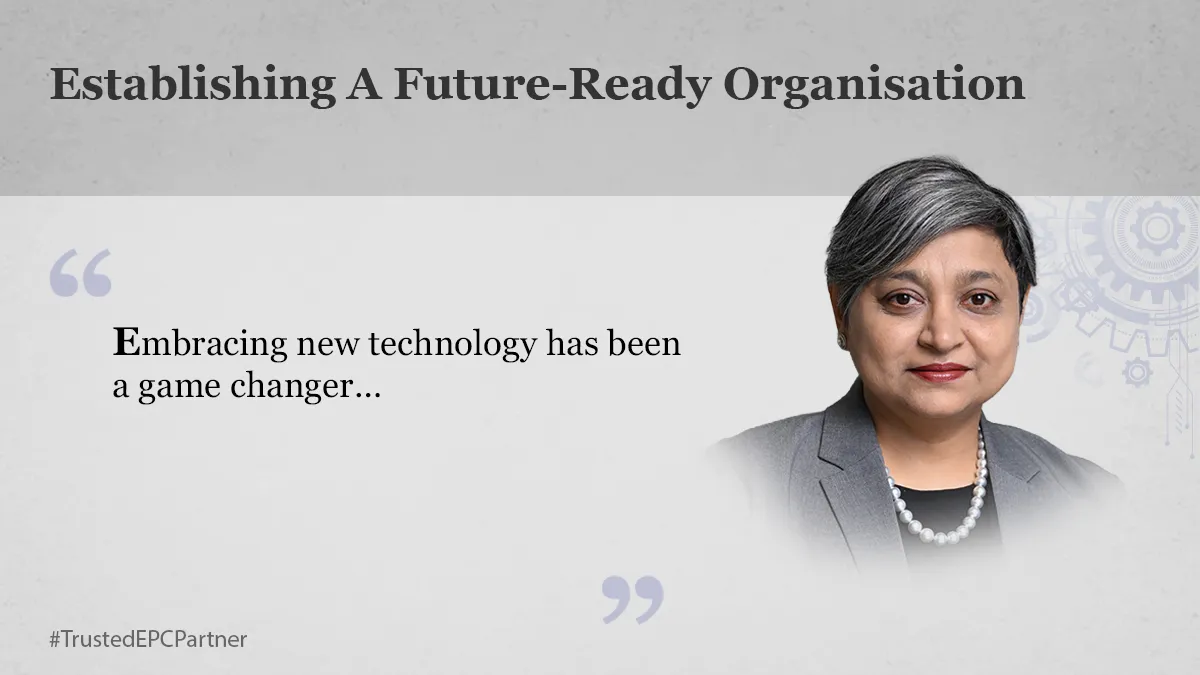
Embracing new technology has been a game changer – especially in an industry where timely delivery is supreme. As a construction leader, streamlining operations will help unlock new efficiencies. Our constant desire to discuss, adapt and innovate can only spell success.
Preiti Patel
Chief Strategy & Growth Officer
Tata Projects Limited
Simplify. Create.