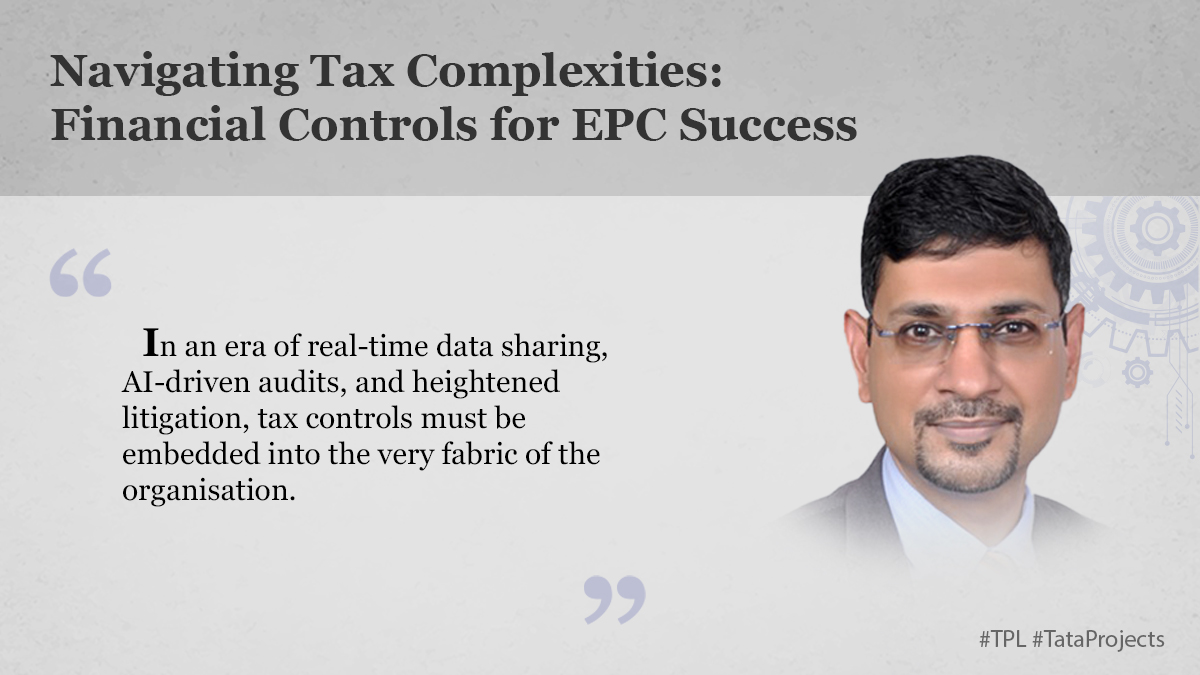
Navigating Tax Complexities: Financial Controls for EPC Success
In the intricate world of Engineering, Procurement, and Construction (EPC), financial controls have evolved from being mere accounting tools to becoming strategic instruments of governance. Today, they are central to ensuring tax compliance, managing risk, and safeguarding organisational integrity in an increasingly complex regulatory environment. At Tata Projects, we operate across diverse geographies and under varied contractual frameworks. This naturally brings with it a web of tax obligations—each demanding precision, foresight, and cross-functional collaboration. Gone are the days when tax compliance was the sole domain of finance teams. Today, HR must consider payroll taxes, bidding teams must factor in applicable levies during tendering, legal must anticipate tax implications in contracts, and administration must negotiate with an eye on GST credits. Tax awareness is now a shared responsibility.
Income Tax: Structuring for Compliance and Efficiency"
EPC contracts are rarely straightforward. Structuring them correctly—whether as split or composite contracts, or through joint ventures or consortiums—can significantly impact tax outcomes. Each decision must be weighed not just for commercial viability but also for tax efficiency. Income tax complexities abound. Payments to subcontractors, consultants, and suppliers often fall under multiple TDS provisions, each with its own nuances. Cross-border transactions add another layer, requiring careful analysis of tax treaties and withholding obligations. Even revenue recognition poses challenges, with timing mismatches between client deductions and our own accounting methods leading to reconciliation issues. Then there’s the risk of Permanent Establishment (PE) in foreign jurisdictions—a concern that demands rigorous due diligence before stepping into international projects. A misstep here could expose the organisation to unexpected tax liabilities abroad.
Indirect Taxes: The Devil in the Details
GST and Customs duties present their own set of challenges. EPC contracts typically involve composite supplies, taxed as works contracts at 18%. Yet, the underlying procurements may attract varied rates—5%, 12%, 18%, or even 28%. Determining the correct classification is not just a compliance requirement; it’s a financial imperative. Long-term contracts must be future proofed with clauses that allow for price adjustments in response to changes in tax laws. And while vendor GST compliance might seem like a back-office concern, it has direct financial consequences. Non-compliant vendors can lead to loss of input credits, increasing project costs and eroding margins. Customs regulations, too, require vigilance. Export benefits hinge on timely realisation of proceeds, while import transactions demand accurate HSN classification and duty assessment. A lapse in either can result in regulatory scrutiny or financial setbacks.
Building a Culture of Tax Governance
In an era of real-time data sharing, AI-driven audits, and heightened litigation, tax controls must be embedded into the very fabric of the organisation. At Tata Projects, we view tax governance not as a checklist, but as a culture—one that reflects our commitment to ethical conduct and regulatory excellence.
A robust tax control framework encompasses:
- Compliance: Timely tax payments and filing of tax returns.
- Reconciliation: Regular matching of books with tax records to pre-empt discrepancies.
- Documentation: Maintaining comprehensive records especially for key tax positions, input credits, exemptions, and cross-border dealings.
- Risk Management: Identifying and auditing high-risk areas, including related-party transactions and vendor compliances.
- Litigation & Advisory: Tracking assessments, appeals, and maintaining a repository of legal opinions and rulings.
These controls are supported by a strong governance structure—where leadership sets the tone, risks are proactively assessed, and information flows seamlessly across teams. Internal audits, tax health checks, and external reviews ensure that our systems remain resilient and responsive.
Compliance as a Core Value
There’s a well-known legal maxim: “Ignorance of the law is no excuse.” For large corporates like ours, this principle is not just a caution—it’s a call to action. Tax litigation, whether with authorities or clients, is costly and disruptive. Avoiding it requires not just technical expertise, but a deep-rooted culture of compliance.
At Tata Projects, adherence to the law is not a tick-box exercise—it’s part of our DNA. It reflects the values of the Tata Group and reinforces the trust we’ve built with stakeholders across the globe. As we navigate the complexities of the EPC landscape, our commitment to robust financial controls and tax governance remains unwavering.
Vikas Garg
Vice President – Finance & Accounts (Head - Taxation)
Tata Projects Limited
Simplify. Create.