What Are Financial Controls?
Financial controls encompass all company activities that impact its financial position, as measured through key performance indicators and management information systems. At their core, financial control measures involve identifying, estimating, and accurately accounting for assets and liabilities in line with industry standards and internal policies. This transparent approach ensures that the company’s financial statements present a true and fair view.
But financial controls go beyond numbers. Operational control measures—a key component of financial controllership—are about safeguarding company assets, both internally (through monitoring and ageing) and externally (by preventing theft, loss, or misappropriation). They involve regular physical verification, effective monitoring, and timely liquidation of liabilities. Together, these practices provide management with reasonable assurance that organisational objectives will be achieved, and risks will be proactively managed.
Building a Robust Internal Control System
An effective internal control system is the backbone of financial control. It is a continuous process, driven by leadership and embedded across all levels of the organisation, designed to ensure:
- Effectiveness and efficiency of operations
- Reliability of financial reporting
- Compliance with applicable laws and regulations
Key Types of Financial Controls
To achieve these objectives, the following controls must be established and rigorously implemented:
- Internal Accounting Controls: Ensure reliability and accuracy of financial records and reporting.
- Operational Controls: Drive efficiency in day-to-day operations.
- Physical Controls: Safeguard company assets from misuse or loss.
- Authorisation Controls: Implement Segregation of Duties (SoD) to maintain checks and balances.
- Management Controls: Regularly review management accounts against Annual Operating Plans (AOP).
- Organisational Controls: Clearly define delegation of authority and responsibility.
Elements of Effective Internal Controls
A robust internal control system relies on five foundational elements:
- Control Environment: Cultivates integrity, ethical values, and a culture of accountability.
- Risk Assessment: Identifies and mitigates risks across business processes.
- Control Activities: Establishes both preventive and detective controls to address risks.
- Information & Communication: Ensures timely and effective communication throughout the organisation.
- Monitoring: Regularly evaluates controls and reports findings to top management.
Who Is Responsible?
Implementing and maintaining effective financial controls is a shared responsibility:
- Top Management: Sets the tone for integrity, ethics, and competence.
- Departmental Heads: Oversee internal controls within their units.
- Managers & Supervisors: Execute control policies and procedures.
- All Employees: Are accountable for internal controls related to their roles.
The internal audit function plays an essential role by independently examining the adequacy and effectiveness of financial controls and recommending improvements where necessary.
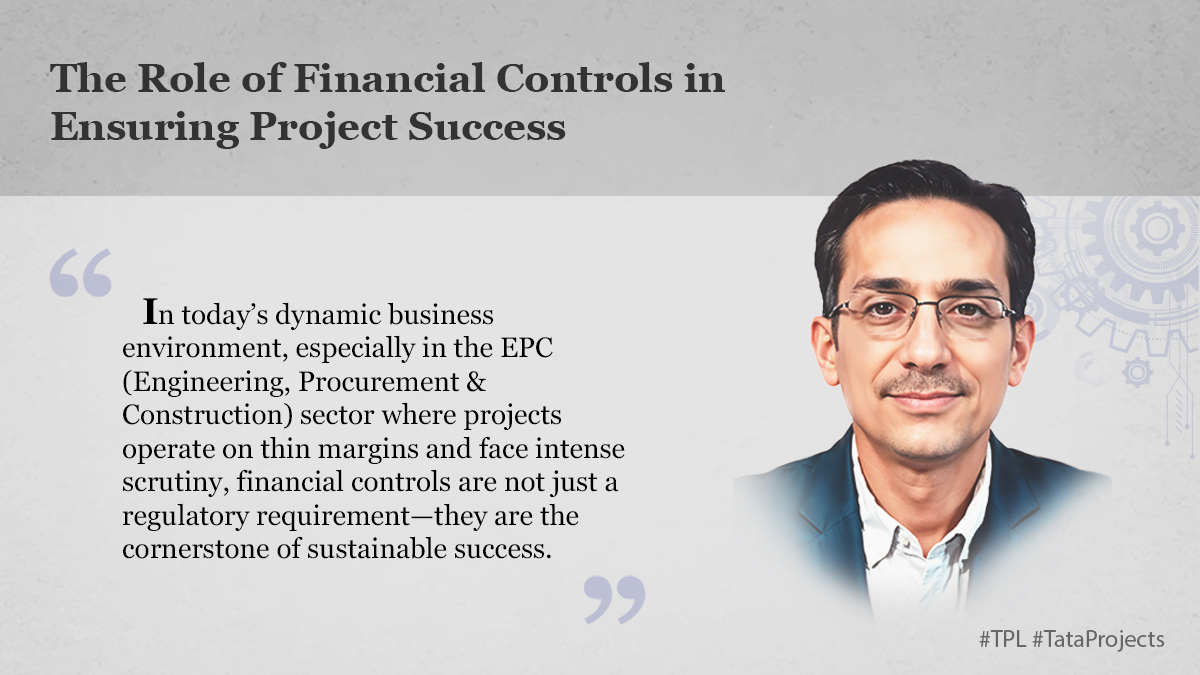
In an era of heightened regulatory scrutiny, robust financial controls are not optional—they are essential. For sectors like EPC, where projects are complex and margins are tight, strong financial controls are nothing less than a license to operate and a lifeline for sustained business success.
Sunil Luthra,
Vice President, Financial Controls
Tata Projects Limited
Simplify. Create.