Intellectual Capital

Our vision of delivering predictable and sustainable projects through innovation and technology is a thread running through every digital initiative we undertake. We are on a focused journey of deepening adoption, building stronger collaboration between technology and business, and progressively realising measurable value from our digital investments. FY2026 has been a year of meaningful forward movement in that journey.

Engineering a
Smarter Tomorrow

Key Highlights of FY2026

  • ₹128 Cr

    Reported Savings from Innovation

  • 175

    Innovations (5% Increase from Previous Year)

  • 50

    Project Sites Live on Digital ESG Platform

  • 4,500+

    Digital Quality Inspections Logged

  • 40%

    Growth in AI-assisted Productivity Tool Usage in March 2026 Alone

  • ₹20 Cr

    Cost Avoidance from Inventory Rationalisation (within 5 Months)

  • ₹45 Cr

    Savings from Real-time Equipment Tracking and Redeployment

Key Focus Areas

  • Digital Project Delivery from proof-of-concept enterprise-wide deployment
  • AI to solve specific, high-cost operational problems in project delivery, contract management, quality assurance and safety

Alignment with SDGs

  • UN Sustainable Development Goal 8: Decent Work and Economic Growth
  • UN Sustainable Development Goal 11: Sustainable Cities and Communities
  • UN Sustainable Development Goal 12: Responsible Consumption and Production
  • UN Sustainable Development Goal 13: Climate Action

The construction industry is at a decisive inflection point. The organisations that will lead the next decade are not those that simply adopt technology; they are those that embed it as a core strategic capability, indistinguishable from how they deliver and compete.

The engineering and construction industry is entering a new era where digital capabilities are no longer a source of differentiation; they are becoming fundamental to business success. As project complexity increases and client expectations evolve, technology must move beyond enabling operations to becoming an integral part of how organisations execute, innovate and grow.

At Tata Projects, we have consciously repositioned Digital and Information Technology from a support function to a strategic business capability. Today, technology is embedded across the project lifecycle - from bid management and engineering to construction, supply chain, project controls and operations - enabling greater visibility, predictability and data-driven decision-making.

During FY2026, we continued to advance this transformation with a clear objective: to deliver predictable and sustainable projects through technology. Every digital initiative is evaluated through the lens of business value, operational efficiency, customer outcomes and long-term competitiveness. This disciplined approach ensures that technology investments create measurable impact while supporting our broader business strategy.

Our digital roadmap is guided by four principles: value-led delivery, continuous improvement and cost optimisation, deep business collaboration, and disciplined innovation. These principles shape every solution we design, every platform we deploy and every capability we build.

Over the past year, we accelerated the adoption of integrated digital platforms, advanced project controls, data analytics, automation and AI-enabled capabilities to strengthen execution excellence across our projects. We also continued to build a secure, scalable and resilient digital foundation that supports collaboration across our project sites, offices and partner ecosystem.

Digital transformation is not only about technology; it is equally about people. We have invested in strengthening digital capabilities across the organisation, empowering our teams to embrace new ways of working and fostering a culture of innovation, continuous learning and informed decision-making.

As India embarks on an unprecedented phase of infrastructure development, the ability to execute complex projects with speed, precision and predictability will define industry leadership. We remain committed to harnessing technology as a strategic enabler of this journey - building smarter projects, creating greater value for our stakeholders and shaping the future of engineering and construction.

Technology will continue to be central to how we deliver today, and how we build the future.

Vaibhav Palan Chief Digital and Information Officer

From Technology Support to Business Capability

At Tata Projects, the Digital and IT function has gone through a deliberate and fundamental repositioning - from a service function that responded to business requests to an enabler of competitive advantage.

This transformation is anchored in a clear strategy guided by four governing principles:

  • Value-based Delivery
  • Cost Optimisation and Continuous Improvement
  • Deeper Business Collaboration
  • Disciplined Innovation

This shift is based on a clear vision:

Deliver predictable and sustainable projects through innovation and technology.

What This Means

Predictability is what our clients expect, sustainability is what our business prioritises, and technology is how we deliver both consistently, at scale, and with integrity.

Technology in Project Execution

The most commercially significant progress in FY2026 is the transition of digital project delivery from proof-of-concept to enterprise-wide deployment. Digital workflows are now embedded across all seven stages of the project lifecycle from pre-award through execution to close-out. This is a fundamental change in how Tata Projects delivers.

A Unified Data Backbone

In FY2026, we formalised our Integrated Digital Project Delivery (IDPD) framework, embedding BIM, VDC, Digital Twins, and AI-driven analytics as standard across projects. This has strengthened collaboration through 3D and 4D BIM, enabled by a Common Data Environment (CDE), our single source of truth for design and execution data, improving coordination, standardising information flow, enabling real-time access, and enhancing lifecycle visibility. We also took some significant steps early towards model-based project delivery, with select projects operating within integrated digital environments where drawings, documents, and design data are centrally managed, ensuring that the right information reaches the right teams at the right time.

The IDPD framework is supported by tools such as Assemble, Power BI, and Robotic Total Stations, while document and design platforms are now live across most major projects, reinforcing a version-controlled, single source of truth. The CDE, mandated across all new projects, anchors data governance, further strengthened by our evolving data lake house architecture and initiatives like the Tower Manufacturing Dashboard, extending BIM-linked intelligence into manufacturing operations.

Case Study

Transforming Project Delivery through BIM

The Air India MRO facility in Bengaluru served as the flagship pilot for Tata Projects' Integrated Digital Project Delivery (IDPD) framework.

BIM-led coordination and digital workflows delivered a 27% reduction in rework, faster construction document retrieval, and improved execution precision through tools such as Robotic Total Station and Power BI analytics.

Impact

The pilot created a strong foundation for scaling digital delivery across the organisation, leading to the mandating of the Common Data Environment (CDE) for all new projects. The approach also gained international recognition at Autodesk University 2025, strengthening Tata Projects' leadership in digital transformation.

Occupational Health and Safety through Real-time Execution

Digital assurance has strengthened through Hubble Build, our mobile-first quality and HSE platform, enabling real-time inspections, compliance tracking, and site monitoring. In FY2026, it recorded over 4,500 inspection and compliance submissions across more than 80 projects, with strong adoption and full transition of quality metrics onto digital workflows. Real-time dashboards are improving visibility, traceability, and response times across sites.

Site execution has been transformed through end-to-end digital workforce management across more than 50 projects, automating attendance, compliance, and productivity tracking while eliminating paper-based processes. Digital quality and safety platforms ensure tamper-proof records, while drones, 360-degree walkthroughs, and timelapse cameras provide continuous remote visibility. AR/VR training and AI-driven surveillance further strengthen safety culture.

In procurement and materials management, digital systems flag redundant requests by identifying available stock across sites, enabling cost optimisation. Digital vendor onboarding and mobile-enabled approvals have reduced cycle times and strengthened governance, while end-to-end digitalisation of procurement and PO-to-pay processes have improved productivity, cost efficiency, and transaction transparency.

Fibre-optic strands fanning out in blue and orange light

Strengthening Digital Governance and Audit Oversight

LARS digitalises the internal audit lifecycle by connecting the management, auditees, and audit teams on a single platform. Automated workflows, collaborative document sharing, and live dashboards reduce delays, improve closure discipline, and provide clear visibility into audit status, observations, and corrective actions, enabling a fully paperless audit process.

A live project governance dashboard provides real-time plan-versus-actual visibility, eliminating reporting lags and enabling faster decision-making. Digital invoice management is also progressing towards full automation of the procurement-to-pay cycle, improving transparency and control. Our ERP system provides the structural support to our digital infrastructure, with 100% of projects running on it and all purchase orders, invoices, budgets, and cost-to-complete calculations managed within the system, eliminating manual workarounds and reducing errors.

AI-powered Decisions Make Business Smarter

We deploy AI with a focused approach towards addressing high-impact business challenges and enhancing operational excellence across the project lifecycle.

Our key areas of application include:

  • Project Delivery
  • Contract Management
  • Quality Assurance
  • Safety

Our approach is guided by strong governance and execution discipline, ensuring that AI is applied where it delivers measurable value, instead of being just a symbolic adoption. An AI Steering Committee, comprising the CEO, CDIO, CFO, and Business Unit heads, provides oversight, ensures accountability, and reviews the AI portfolio on a quarterly basis. Every initiative is aligned to a formally approved AI strategy, with investments phased, linked to clear ROI, and tied to measurable business outcomes. This structured approach enables scalable adoption, builds internal capability, reduces dependence on external vendors, and reinforces trust among clients, employees, and stakeholders.

In FY2026, multiple AI-led solutions moved from concept to deployment, strengthening efficiency across the organisation. A range of AI applications are now live across the organisation:

  • TenderSummAIze (built on Azure OpenAI and Document Intelligence) is being used by over 200 users across more than 40 large tenders, improving processing speed, accuracy, and bid responsiveness, and earning recognition at the CII AI Summit.
  • AI-powered site surveillance enables 360-degree walkthroughs and real-time safety monitoring, integrated within the IDPD framework.
  • VR-based safety training, deployed at the Micron Semiconductor Plant in Sanand using 24 Oculus Quest 2 headsets, has trained over 5,400 workers across critical safety modules.
  • Persona-based SAP Fiori interface enhances ERP usability through AI-driven, role-based experiences.
  • AI-enabled quality training modules are being developed to support scalable, self-paced learning.
  • AI-driven innovations, such as an Automatic Guided Vehicle, have also been showcased at Group innovation platforms.
  • A structured enterprise AI literacy programme has been designed to upskill employees across eight functions of quality, safety, bidding, project controls, engineering, procurement, site operations, and finance, embedding domain expertise into reusable AI workflows.

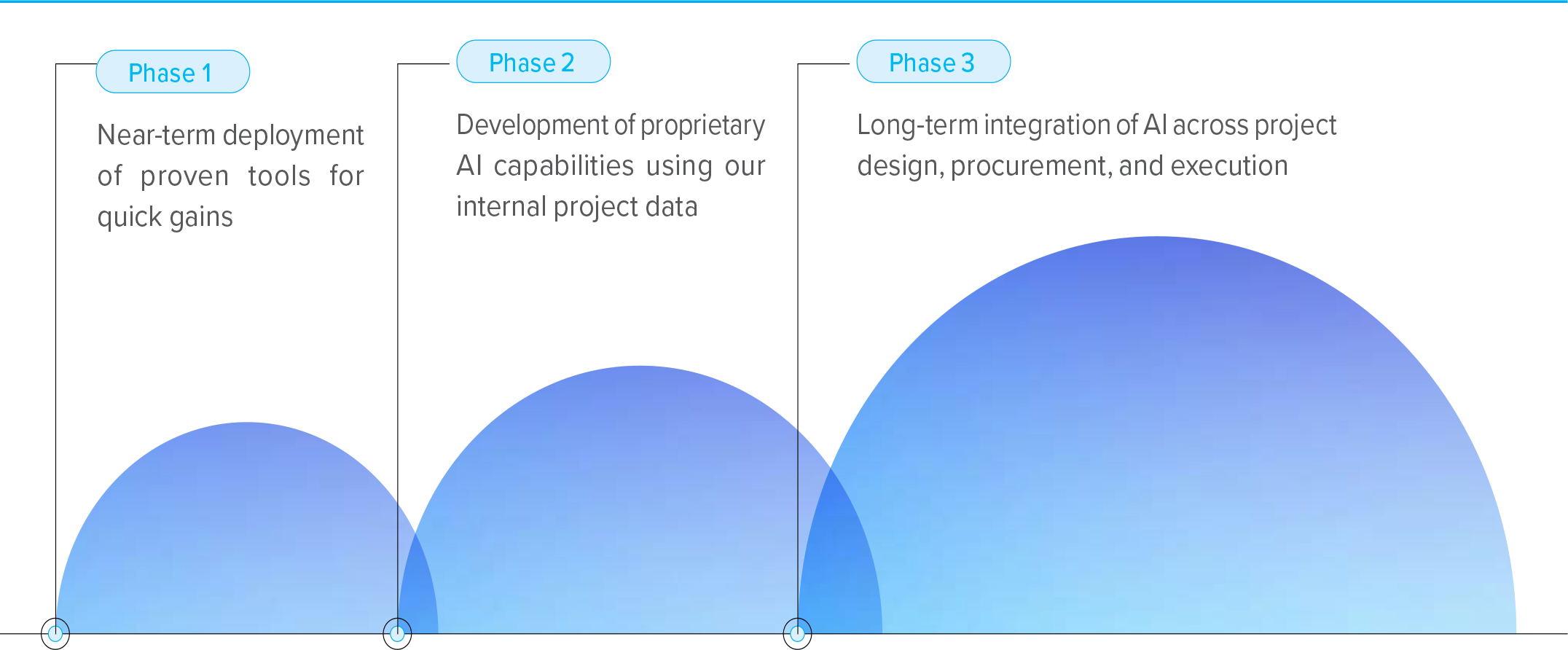
Our AI Roadmap is Structured in Three Phases

Three-phase AI roadmap growing from near-term deployment to development of proprietary capabilities to long-term integration

Our AI focus includes improving bid management, enhancing site safety, enabling scalable workforce onboarding, and strengthening ERP efficiency. AI is not an optional capability - it is an increasingly critical lever for competitiveness, margin protection and client confidence.

Every AI investment at Tata Projects is ROI-linked, CXO-governed, and phased, balancing innovation with disciplined execution and measurable business outcomes.

Digitally Enabling Excellence in ESG

In FY2026, we transitioned from manual, Excel-based ESG data consolidation to a fully digital, platform-driven approach to strengthen accuracy, consistency, and timeliness in sustainability reporting. Earlier processes relied on fragmented inputs from site-level ESG SPOCs, which were time-consuming and prone to inconsistencies. To overcome these limitations, we introduced DAWN as our enterprise ESG performance management platform, aligning with Group-level recommendations for a unified ESG IT system.

DAWN, the ESG mascot, holding a sign that reads Hello I am DAWN your ESG mascot

DAWN

DAWN (Data Awareness and Wellness Norm) is our central ESG intelligence platform designed to enable real-time, standardised, and compliant sustainability reporting across projects. It integrates multi-source ESG data into a single database with automated validation, ensuring data integrity and consistency. The platform also provides interactive dashboards for performance tracking and supports reporting aligned to global frameworks such as GRI, IR, BRSR, and UN SDGs.

Strengthening ESG Decision-making

The shift to DAWN has significantly improved the quality and speed of ESG decision-making across projects. It has reduced manual effort, minimised errors, and enabled real-time monitoring of sustainability performance. Standardised data formats and automated validations have enhanced reliability, while dashboard-based insights have improved transparency and stakeholder reporting efficiency.

Organisation-wide Rollout

The DAWN rollout was continued across all SBGs, with the initial cohorts supported by structured training sessions for site-level ESG SPOCs to integrate the platform into day-to-day workflows.

Culture of Innovation and Collaborative Ecosystem

At Tata Projects, innovation is driven by both internal ingenuity and external collaboration. We nurture a strong culture of bottom-up innovation by empowering employees to contribute ideas that improve operations, technology, and project execution, while also building partnerships with technology leaders, academia, startups, and industry institutions to accelerate implementation and scale impact. These efforts together strengthen our ability to solve complex challenges, create measurable value, and build future-ready capabilities across the organisation.

Innoways 3.0

Innoways 3.0 strengthened to the culture of innovation in FY2026. The platform recognised 300 employees, with operational and process excellence leading through 125 submissions, followed by design excellence and sustainability Impact. MSI SBU (B&I SBG) recorded the highest participation.

Major Innovations in FY2026

Key innovations implemented include BIM-enabled construction progress review, automation of tunnel BIM modelling using Revit and Dynamo, design optimisation of C276 material, TBM segment value engineering, and engineering innovation in 765 kV tower design. Additional site-level innovations such as GeoTPL (geotechnical parameter logger), CNA modular erection, heavy bracket systems, pre-caging and spreader beam arrangements, and drone-based photogrammetry surveys have further enhanced execution capabilities, precision, and monitoring.

The innovation portfolio demonstrates strong impact across productivity and quality, with digital and engineering-led solutions improving accuracy, speed, and decision-making. Safety and capability building have also been strengthened through innovations like frontline skill development and improved erection methodologies, while technology-led monitoring solutions contribute to better control and risk reduction.

These innovations collectively drive value through improved construction efficiency, reduced rework, optimised material usage, and faster execution cycles. Digital tools and engineering optimisations have enhanced accuracy and reduced errors, while mechanised and modular approaches have improved productivity and resource utilisation.

TPL was awarded CII Industrial Innovation Award for GSSP Rating as follows:

  • Innovation Culture - Gold
  • Innovation Management - Silver
  • Inputs to Innovation - Silver
  • Innovation Results - Platinum

Innovation Ecosystem and External Partnerships

  • Promotion of Innovation within TPL

    Innovation continues to be driven through structured platforms, with a strong focus on engineering-led improvements, digital adoption, and frontline-driven ideas. Initiatives such as skill building, site-led innovations, and integration of digital tools like BIM and automation platforms are enabling a culture of continuous improvement and innovation adoption.

  • Key External Partners in FY2026

    External collaboration has been integral, particularly in areas such as BIM tools, automation (Revit and Dynamo), drone-based surveys, and advanced engineering solutions. Technology providers and specialised partners have supported implementation of digital and engineering innovations across projects.

  • Pilots Progressed to Deployment

    Several innovations have transitioned from concept to execution, including BIM-based progress tracking, drone-enabled surveys, modular erection techniques, and mechanised construction arrangements, which are now being applied across multiple projects.

  • Pipeline of Technology Partnerships

    A strong pipeline is being sustained through continued focus on digital engineering tools, automation solutions, geotechnical monitoring systems, and drone technologies, ensuring ongoing identification, piloting, and scaling of relevant innovations aligned to business needs.

  • Idea Playbook

    The Idea Playbook crossed the milestone of more than 100 ideas submitted in March 2026, reflecting strong employee participation in ideation. The leading contributor came up with 28 ideas, while ATF recorded the highest submissions among SBUs with 33 ideas. Contributions were led by BlueSky ideas (77), followed by theme-based (15) and horizontal ideas (eight), with four already under implementation.

  • Kaizen Drive

    The Kaizen Drive delivered 57 Kaizens, reinforcing a culture of continuous improvement through the launch of Kaizen App as a digital platform to capture, track, and scale improvement initiatives across the organisation.

  • BE Practitioners Programme (BEPP)

    As part of the Business Excellence Practitioners Programme (BEPP) conducted at the Corporate Office, Mumbai, 15 improvement projects were identified focusing on operational excellence, cost optimisation, productivity enhancement, digitalisation, safety, employee well-being, and project execution effectiveness.

Case Study

Driving Innovation through Tata Innovista and InnFuze

Tata Projects strengthened its culture of innovation through active participation in Tata Innovista 2026 and Tata InnFuze 2026, showcasing solutions such as Nanogence in Concrete Production, LiDAR Chaos to Clarity, and Transparent Shuttering.

Impact

Recognition at the Group level, with Nanogence becoming a pre-finalist, and strong internal engagement with five teams advancing to Stage 2, reinforcing a pipeline of scalable, future-ready innovations.

A close-up of a semiconductor wafer under coloured light

Smart Manufacturing Frontier

We have forayed into Fourth Generation (4G) factories, smart manufacturing facilities that integrate Industrial IoT, real-time data, system integration, and mass customisation. While still at a nascent stage in India, this space represents a key focus area for us alongside emerging opportunities in urban transformation and energy transition.

This shift enables us to move beyond traditional infrastructure and focus on high-tech, higher-margin projects, supporting more predictable and future-ready growth. Landmark projects such as the semiconductor testing facility at Sanand and the tri-sonic wind tunnel for ISRO at Thiruvananthapuram testify to our capabilities in this domain.

Strategic Partnerships and Open Innovation

We are building a robust innovation ecosystem through strategic partnerships and a strong focus on open innovation. Collaborations with leading technology companies, academic institutions, and industry partners are accelerating our digital transformation and enhancing capability development. At the same time, engagement with startups and structured internal knowledge-sharing platforms foster continuous learning, cross-functional collaboration, and innovation-led problem solving across the organisation.

External Partnerships

In FY2026, we strengthened our innovation ecosystem through strategic collaborations with leading technology companies, academic institutions, and industry partners, reinforcing our commitment to digital transformation and capability building. Key engagements included:

  • Autodesk: The IDPD approach showcased at Autodesk University 2025 in Nashville, earning recognition from the global EPC community and reinforcing TPL's position as a technology leader in construction.
  • Microsoft and Azure OpenAI: Enabled the foundation for TenderSummAIze and other AI-powered applications across the organisation.
  • TCS: SAP team supported TCS in defining a digital transformation strategy for a leading North American EPC firm, including on-ground collaboration in North America, highlighting TPL's role as a knowledge exporter.
  • IIT Gandhinagar: Collaborated through industry-academia engagement on the Innovation Day 2025.
  • Proinn Consultancy (TRIZ Methodology): TRIZ-based structured problem-solving using 40 inventive principles.
  • QualityKiosk (RPA): Delivered RPA awareness session for 70 employees, with three use cases from engineering, HR, and finance under feasibility evaluation.
  • TMTC and Tata Group: Supported innovation capability building through programmes such as InnFuze and participation in Innovista.
  • HP Aruba: Partnered on network monitoring and infrastructure technology solutions.
  • Revit and Dynamo: For automation and advanced engineering solutions.
Engineers walking through an industrial pipe gallery

Powering Open Innovation and Knowledge Exchange

We continued to build a culture of innovation-led learning by combining external startup engagement with structured internal knowledge-sharing platforms.

  • Pitch Day Series

    Engaged with startups offering solutions in sustainable construction systems, augmented reality for project controls, concrete decarbonisation, and modular automated building methods, strengthening our open innovation ecosystem.

  • Gyan Sagar Domain Meets

    Facilitated structured knowledge-sharing sessions to deepen technical understanding and enable cross-functional learning across domains.

  • Quality Connect Series

    Enabled organisation-wide exchange of best practices and expertise, supporting continuous learning and strengthening internal innovation capability.

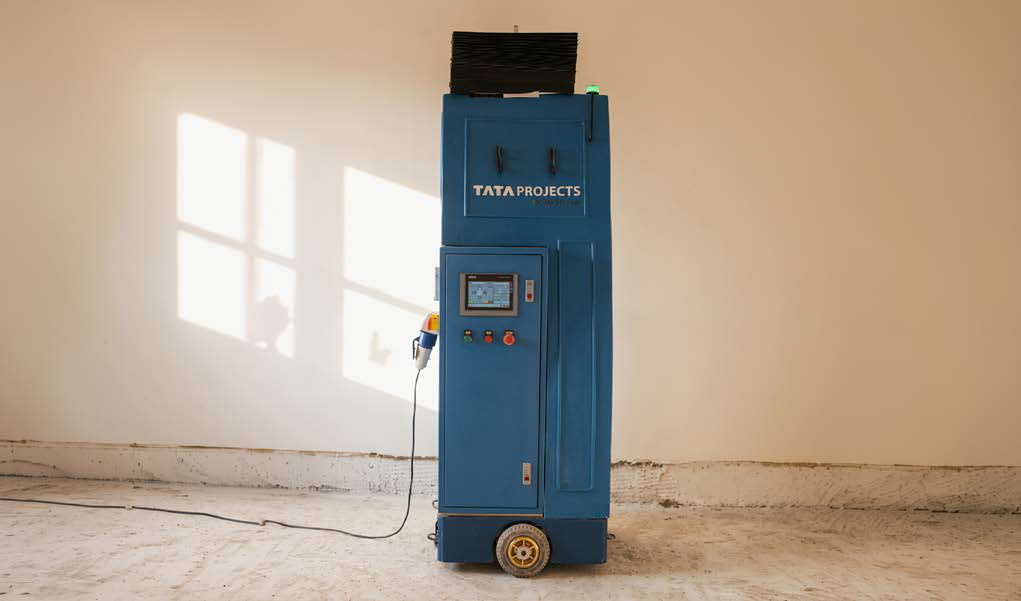
The Automatic Surface Modifying Robot standing beside a freshly painted wall

Patents and Intellectual Property Pipeline

We have established a structured innovation ecosystem that transforms employee ideas into protected intellectual property through platforms such as the Idea Playbook, innovation capability development programmes, Innoways, and Tata Group initiatives including Tata Innovista and Tata InnFuze.

A major milestone in FY2026 was the grant of a patent for the Automatic Surface Modifying Robot, marking a significant step in strengthening our intellectual property portfolio and reflecting our commitment to engineering-led innovation.

Developed entirely in-house, the Automatic Surface Modifying Robot redefines wall painting through automation. The innovation is the culmination of nearly three years of sustained development, involving three major iterations, continuous site-based learning and close collaboration across our design, engineering, execution, testing and intellectual property teams. Evolving from a rugged tri-wheel, servo-driven prototype into a first-of-its-kind autonomous system with enhanced automation and integrated end-effector capabilities, the solution delivers 11x higher productivity, 80% lower labour dependency and 30% lower paint consumption, while significantly improving safety, quality and sustainability.

The innovation was recognised throughout its development journey, receiving accolades as an Innoways 2.0 Winner, at Domain Meets, and as a Tata Innovista Pre-finalist, before culminating in the grant of the patent. The patent underscores the novelty of the innovation and reinforces our ability to transform engineering excellence into globally differentiated intellectual property.

This milestone also reflects the strength of our innovation culture. Through platforms such as the Idea Playbook, innovation capability development programmes, Innoways 3.0, Tata Innovista and Tata InnFuze, we continue to nurture ideas, build innovation capabilities and provide opportunities for our teams to develop, protect and scale breakthrough solutions that create long-term business value.

Two colleagues reviewing data together on a tablet in a dark operations room

Resilience through Security, Data Governance and Trust

As we widen our digital footprint, the security of our systems and the integrity of our data become strategic imperatives, not compliance obligations. In FY2026, our cybersecurity posture shifted from reactive to pre-emptive - with investments in architecture hardening, operational resilience and proactive threat intelligence now treated as foundational to business continuity.

Data is increasingly the biggest strategic asset for Tata Projects. Our commitment to the Digital Personal Data Protection (DPDP) framework and to responsible data governance reflects a deeper conviction: trust, once lost, is far harder to rebuild than any technology system. We are building governance that honours both the power of data and the responsibility it carries - consistent with Tata Group's highest standards of integrity and transparency.

Securing the Digital Enterprise

As we expand our digital footprint, safeguarding our systems and ensuring data integrity have become strategic priorities, rather than mere compliance requirements. In FY2026, we strengthened our cybersecurity posture by shifting from a reactive to a proactive approach, with focused investments in resilient architecture, operational security, and advanced threat intelligence. At the same time, we recognise data as a critical strategic asset and remain committed to responsible data governance under the Digital Personal Data Protection (DPDP) framework, upholding the highest standards of trust, integrity, and transparency.

Cybersecurity

We continue to strengthen our cybersecurity posture through a 24x7 Security Operations Centre (SOC), supported by Zero Trust Network Access and Multi-Factor Authentication as core controls. In FY2026, our approach increasingly shifted towards proactive threat prevention and resilience. As of August 2025, we successfully blocked 80 malicious activities, intercepted 4,908 malicious URLs, and prevented over 16,300 malicious emails, including phishing and malware attempts, while proactively removing 3,357 threats from user mailboxes.

To test organisational readiness, we conducted a Company-wide Cyber Drill involving over 30 participants, including senior leadership and the Executive Committee. Reinforcing our leadership in this space, our CISO was recognised with the AI Visionary 2025 award at the 17th Annual CISO Forum.

A glowing digital shield ringed by circuitry

Information Security and Risk Governance

We have established a comprehensive and formally documented governance framework to safeguard information assets and manage digital risk, covering the confidentiality, integrity, and availability of systems, data, and IT resources. We follow a layered approach to security, spanning technical, administrative, and physical controls with defined risk treatment plans and strict governance over exceptions.

Our governance framework is supported by the following key documents:

  • Information Security Policy

    Provides the foundation for all security standards, guidelines, and procedures for protecting organisational information and applies to all employees, contractors, consultants, and third-party vendors. The policy is reviewed annually, with oversight from the Information Security Committee chaired by the CDIO, ensuring alignment with evolving risks and organisational priorities.

  • IT Risk Management Policy

    Defines a structured process for identifying, assessing, mitigating, and monitoring information security risks, with clearly assigned risk owners across systems and infrastructure. Risk assessments are conducted at least annually, supported by a live security and risk register maintained by the CDIO and periodically reviewed by senior leadership.

Data Integrity and Cyber Resilience

As data becomes an increasingly strategic asset, we have strengthened our digital ecosystem to ensure the integrity, security, and responsible use of information across the organisation. Structured digital workflows enforce standardised and validated inputs across systems, improving data consistency, reliability, and traceability. Our commitment to data protection is aligned with the Digital Personal Data Protection (DPDP) framework and Tata Group's standards of integrity and transparency. In FY2026, we conducted four formal security assessments, including internal, Blue Tick, and independent external reviews such as a Microsoft-led assessment.

We continue to enhance the resilience and effectiveness of our enterprise systems through ongoing digital transformation initiatives. The implementation of SAP S/4HANA has strengthened operational control, process efficiency, and mobile-enabled decision-making, while our first SAP Production Disaster Recovery Drill validated zero data loss and uninterrupted business continuity. Procurement and supplier governance were further strengthened through SAP Ariba SLP, incorporating automated compliance checks such as PAN and GST validation, alongside enhanced technical evaluation capabilities. Additionally, operational innovations such as the DIY Material Extension Kit have significantly reduced processing time and improved efficiency across workflows.

  • Zero Breaches of customer privacy
  • Zero Data leaks, thefts or losses were identified
  • 39% Workforce reached through Cybersecurity awareness programmes