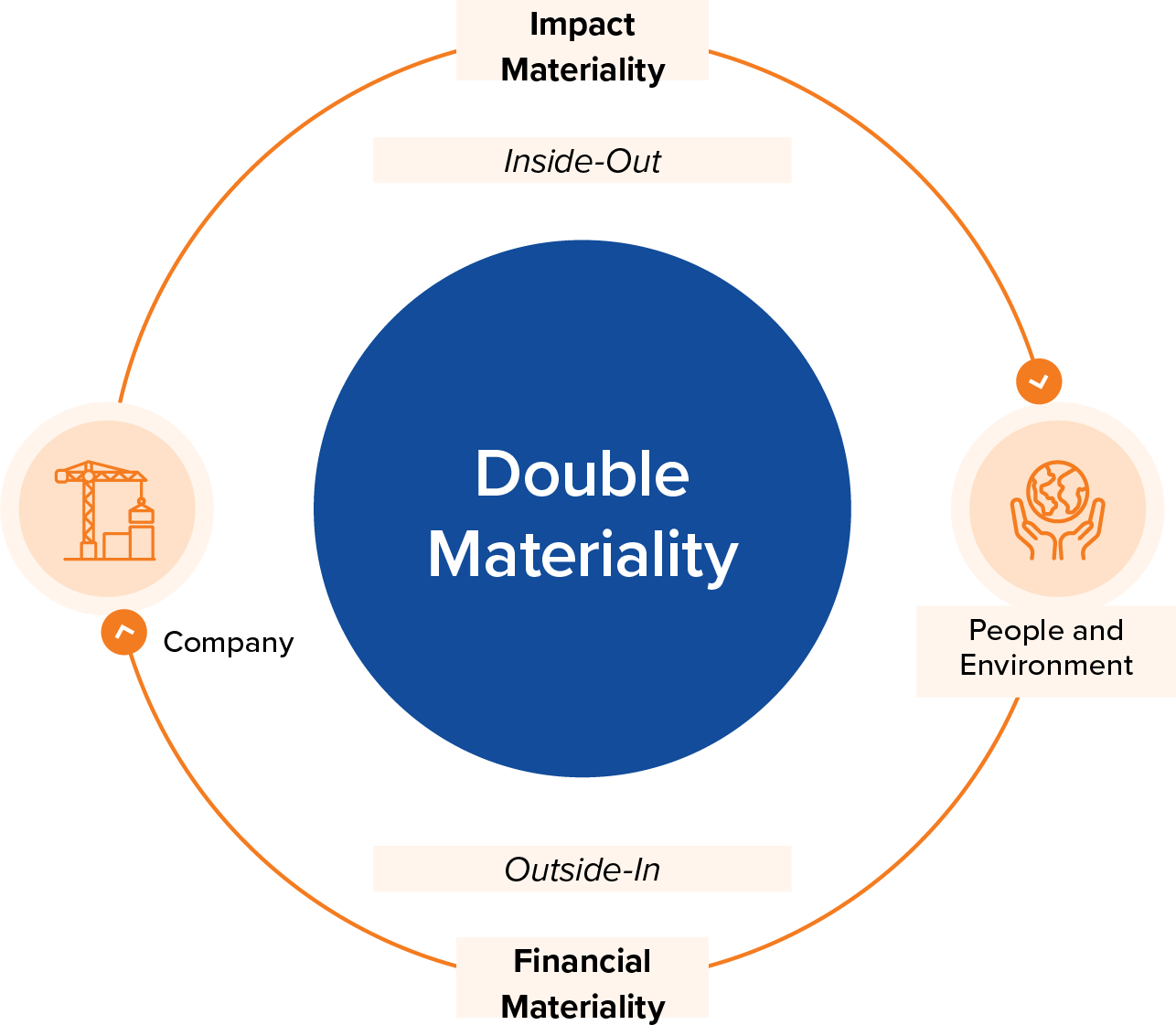
We carried out a double materiality assessment during the year to
identify the ESG topics most relevant to our business and
stakeholders. The assessment was designed to evaluate issues through
two complementary lenses. First, impact materiality, which is based on
the actual and potential effects of our operations on the economy,
environment and the people. Second, financial materiality, which
assesses how sustainability-related issues influence our performance,
risk profile and long-term enterprise value. Through this approach, we
identified high-priority impacts and associated material topics that
will help guide our strategy, disclosure and decision-making, while
reflecting both the way we create value and the way we affect the
world around us.
The Double Materiality Assessment conducted in FY2026 represents an
evolution of the materiality assessment undertaken in FY2023. Key
changes include an increase in the number of priority material topics
and the inclusion of emerging topics such as Data Privacy and
Cybersecurity, Customer Satisfaction, Climate Change, and Land Use &
Biodiversity.
Impact Materiality
Effect the organisation’s operations have on economy,
environment and people
The assessment was carried out in consultation with internal
and external stakeholders
Financial Materiality
Risks or opportunities that may affect enterprise value,
including access to key resources and relationships
The assessment was carried out in consultation with senior
leadership
Approach
Step 1
Define the Scope and Context
We first reviewed our business model, portfolio structure,
operating environment and strategic priorities so that the
assessment reflected how Tata Projects actually operates
across its businesses and value chain.
Step 2
Identify the Universe of Topics
We then prepared a broad list of potential ESG topics
using internal inputs, peer benchmarking, sector
expectations and evolving stakeholder priorities.
Step 3
Assess Impact Materiality
We evaluated the actual and potential impacts of our
activities on society, the environment and our
stakeholders across short-, medium- and long-term
horizons. For this lens, we consulted: Investors,
Suppliers, Customers, Regulatory Authorities and
Government Bodies, Community and NGOs, Employees, the
Sustainability Team, Contract Workers, Industry Bodies and
Trade Associations, and Senior Leadership.
Step 4
Assess Financial Materiality
We assessed how ESG-related issues could influence
business performance, profitability, risk, continuity and
access to resources. For this lens, we consulted Senior
Leadership.
Step 5
Prioritise and Validate
We consolidated the findings into a materiality matrix and
prioritised the issues based on significance, likelihood
and business relevance. The outcomes were reviewed with
management to finalise the high-priority impacts and
associated material topics for Tata Projects.
Materiality Matrix
Priority Topics
Topics that are materially significant from both financial
performance and impacts on external stakeholders.
M1: Customer Satisfaction
M2: Climate Change
M3: Data Privacy and Security
M4: Occupational Health and Safety
M5: Labour Relations Management
Enabler Topics
Topics managed through existing controls, but continuous
performance tracking is necessary. May become priority topics
in the future if stakeholder expectations rises.
M6: Digitalisation and Innovation
M7: Talent Attraction and Retention
M8: Inclusive Development and Wellbeing
M9: Risk Management
M10: Business Ethics
M11: Corporate Governance
M12: Regulatory Compliance
M13: Supply Chain Management
M14: Human Rights
M15: Community Relations
Emerging Topics
Topics that require continuous monitoring and mitigating
actions with respect to the emerging business landscape. Holds
significance for forward-looking readiness.
National Accreditation Board for Testing and Calibration
Laboratories (NABL)-accredited air monitoring as per Central
Pollution Control Board; mist guns, wind barriers
Continuous Ambient Air Quality Monitoring System (CAAQMS) at
National Clean Air Proramme (NCAP) non-attainment city sites
KPIs
% of Air Monitoring and Improvement Unit sites with auto
suppression