
Materiality
Material Matters:
Our Stakeholder Commitment
Material issues are crucial in shaping our sustainability strategy. Through a thorough materiality assessment, we prioritise our strategic objectives, gaining insights into sustainability risks and opportunities. This ensures that our actions align with our values further driving impactful change towards a sustainable future.
Any matter is considered material if it has the potential to significantly affect our ability to create, sustain, and deliver value to our stakeholders in the short, medium, and long term.
Determining Materiality
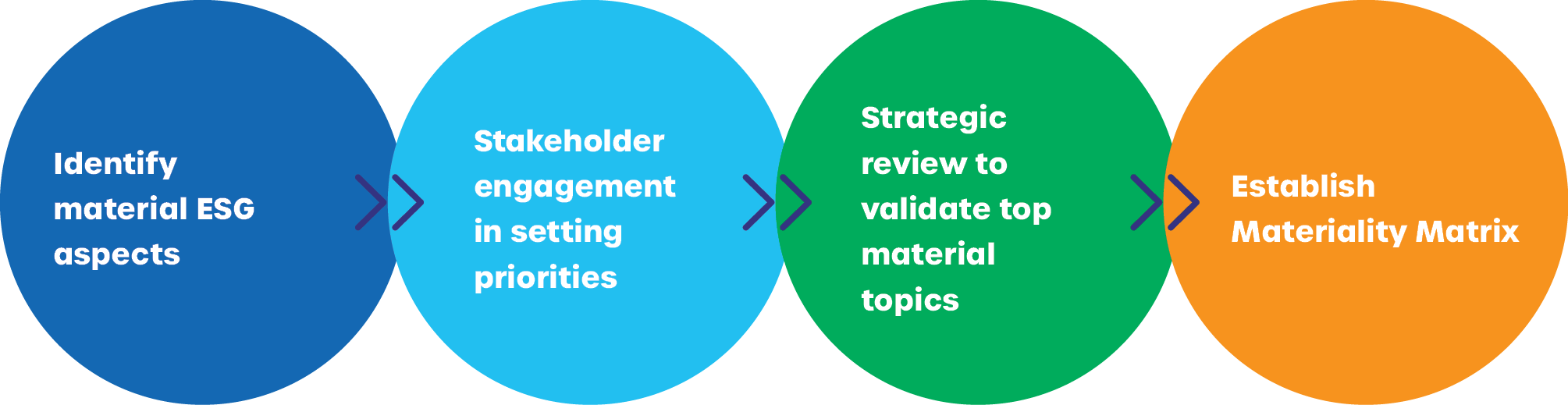
We conducted a comprehensive and structured materiality assessment to ensure alignment with the evolving business landscape. This process involved proactive engagement with both internal and external stakeholders to gain a deeper understanding of the issues that significantly influence their assessments and decisions.
We also collaborated closely with our top management to evaluate the strategic importance of key issues, enabling us to further refine and prioritise the content of this report. As part of our commitment to continuous improvement, we revisited our previous materiality assessment to evaluate its relevance and adequacy in the context of our current business environment.
To reinforce the robustness of our materiality matrix, we conducted dissemination sessions during FY2023. These sessions helped us identify and prioritise issues based on their impact on our business, ensuring that the topics selected accurately reflect our performance, risks, and opportunities throughout the business cycle.

Identify material ESG aspects based on peers, competitors, and industry frameworks and standards

Evaluate and prioritise the issues based on perception of importance for the overall business, and the environment, society and economy

Map the importance of each material issue using a materiality matrix
Identification of Material Issues
After conducting peer benchmark and framework review process, we have identified 17 sustainability issues that are relevant to Tata Projects. These issues are categorised under the three pillars of sustainability: Environmental, Social, and Governance (ESG).

Environment
- Emissions
- Water and effluents
- Green portfolio
- Energy management
- Waste and circular economy
- Bio-diversity and ambient sound monitoring

Social
- Occupational health and safety
- Product safety and quality
- Employee management and development
- Sustainable supply chain
- Diversity and inclusion
- Local community support
- Human rights

Governance
- Business ethics and compliance
- Sustainable corporate governance
- Risk management and business continuity
- Digitisation and innovation
Materiality Matrix
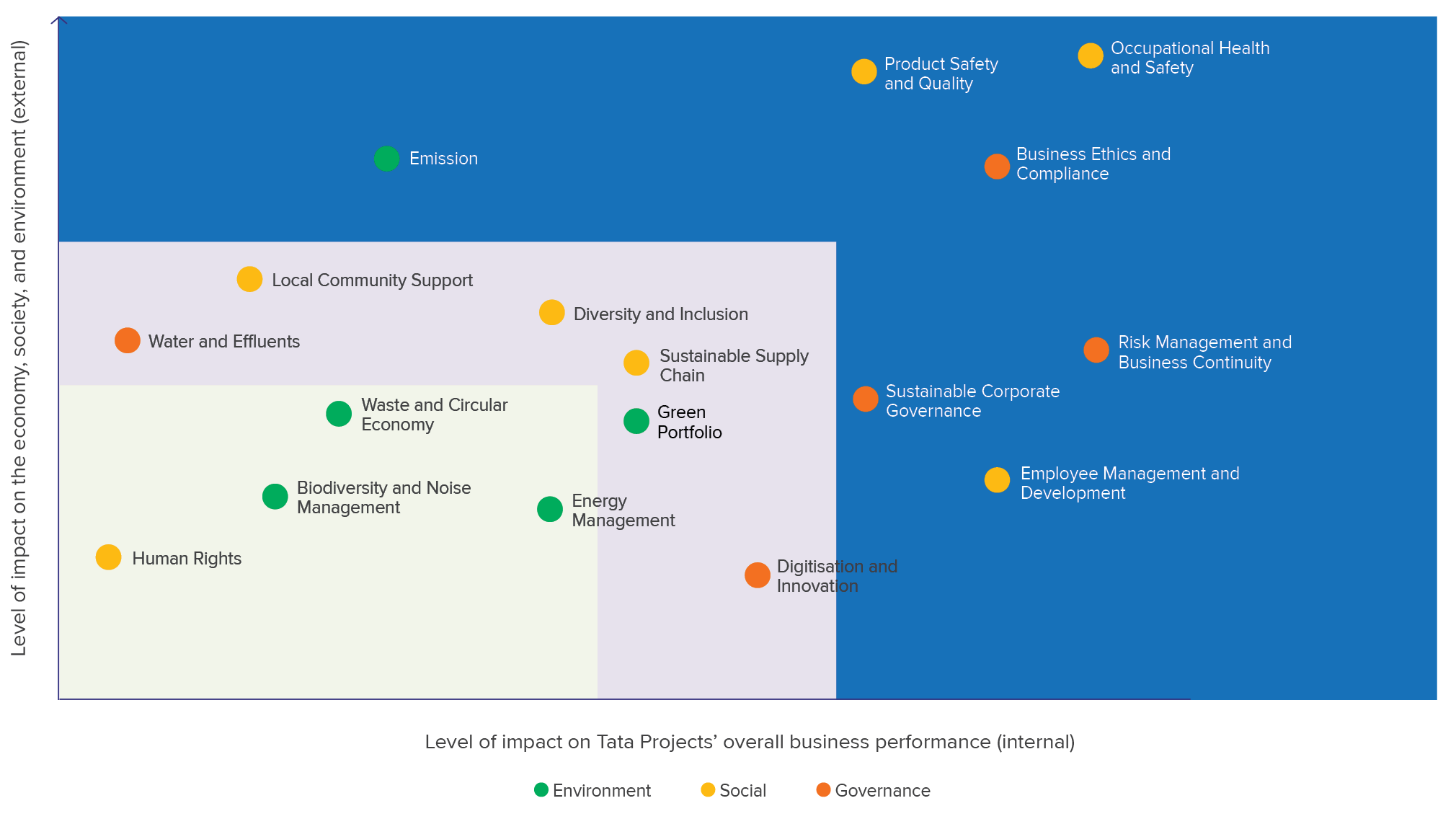
Crucial
These material issues have the highest impact for Tata Projects, and therefore, should be considered priority areas for management to address, improve performance, and report in detail on.
Significant
These material issues have a relatively significant impact for Tata Project and could be considered secondary priority areas for management to address, improve performance, and report on.
Substantial
These material issues are of relatively low priority to Tata Projects due to their minimal potential impact on the Company’s business and operations, and therefore, should be monitored and addressed as needed.
Material Issues

Emissions

Occupational Health and Safety

Product Safety and Quality

Employee Management and Development

Business Ethics and Compliance

Risk Management and Business Continuity

Sustainable Corporate Governance
Key Action Points
- Focused interventions towards monitoring and reducing energy consumption through various energy and emission-saving initiatives
- Goal 1 : Operational discipline (Perform with consistency)
- Goal 2: Managing risk proactively
- Goal 3: Stay connected (Internal / External engagement)
- Create a customer satisfaction survey to understand if the safety & quality expectations of each project is met
- Monitor and report the number of project reconstructions due to safety & quality issues
- Increased training coverage across all levels & technical capability building across sites
- Create an internal talent pipeline to identify emerging talents for potential leadership role
- Comprehensive policies and procedures to drive Business Ethics and compliance which are easily accessible and well communicated
- Proactive review and update of policies to ensure effective risk management and adoption of best practices
- Improving understanding and adherence of policies through communication, training, and monitoring initiatives
- Promoting speak-Up Culture through effective implementation of TPL Whistleblower policy that provides range of channels for raising concerns of actual, suspected, or potential breaches of Code of Conduct principles
- Roll out of integrated risk management programme to acknowledge and address risk at every level
- Deploy ESG roadmap with ambitious targets for each material topic and identify responsible personnel for each target
- Build a better ESG understanding across board executives and BU leaders with compulsory annual ESG training
FY2024 Highlights
- Achieved more than 95% installation of LED in lighting
- TMU 990Kwp & MTHL 330kwp solar power installed and commissioned and fully operational throughout the financial year
- CMRL site bagged Silver & Bronze Green Apple International awards
- PML3 Site Recognised by the Client Pune Metro and awarded for praiseworthy initiative in environment management
- Sustainability team of the year by India Green awards
- Leading indicators show notable progress, with a 13-point drop in the Safety Risk Index.
- Three powerful Risk Reduction Plans were crafted and executed based on data insights, i.e., Monsoon Safety, Working at Heights & Lifting, and Office Safety.
- Weekly Leadership EHS Insights: 45 impactful calls, surpassing targets and covering 5 diverse categories
- Capacity enhancement: Strengthening the incident investigation pool, providing IOSH level 2 training, and conducting joint TPL-customer EHS workshops
- External recognitions: British Safety Rewards, National Safety Council - India, CII Awards and customer recognitions
- EHS differentiated practices include the Safety Risk Index for predicting safety outcomes, the Potential Severe Event programme for injury reduction, and TQDigi’lytics for digital safety management
- Safety & quality expectations were being monitored through the outcome of customer satisfaction survey and external customer survey shall be conducted in FY2025
- TPL Academy Learning Management System (LMS) provides access to the Tata Tomorrow University and National Programme on Technology Enhanced Learning (NPTEL) courses through single sign on
- FLDP batch which was launched in October 2022, is on going with a batch size of 40 participants, 9 out of 10 modules have been completed, and the programme closure is planned September 2024
- A comprehensive framework of Ethics and Compliance policies and procedures including Tata Code of Conduct, TPL Conflict of Interest Policy, TPL Gift and Hospitality Policy, TPL Anti-fraud Policy, TPL Anti Bribery Anti-Corruption policy, TPL Whistleblower policy, Prevention of Sexual Harassment, etc. available on our website www.tataprojects.com
- 100% employees received trainings and / or communications on Code of Conduct expectations
- Continued focus on strengthening the culture of ‘Speak-up’ and effective review of concerns received
- Implementation of a comprehensive Enterprise Risk Management Framework with clearly defined risk assessment criteria. Appropriate options are explored and exercised to bring risk exposure within acceptable limits
- Strengthening of Business Continuity Planning and Crisis Management Framework
- Biodiversity policy was released
- Revised ESG policy & charter were released & communicated across
- Business and Human Rights policy was released

